If you are building a web application that takes payments, Stripe is almost certainly on your shortlist. It is the default choice for developers, the integration of choice for SaaS products, and the payment infrastructure behind some of the largest companies in the world. But before you commit, it is worth understanding exactly what you are paying for.
Stripe fees are simple on the surface but have enough nuance that a lot of developers and founders get surprised later. This post breaks down the full pricing structure, compares it to the main alternatives, and explains why Stripe remains the best choice for most products despite not always being the cheapest option.
The Standard Stripe Fees
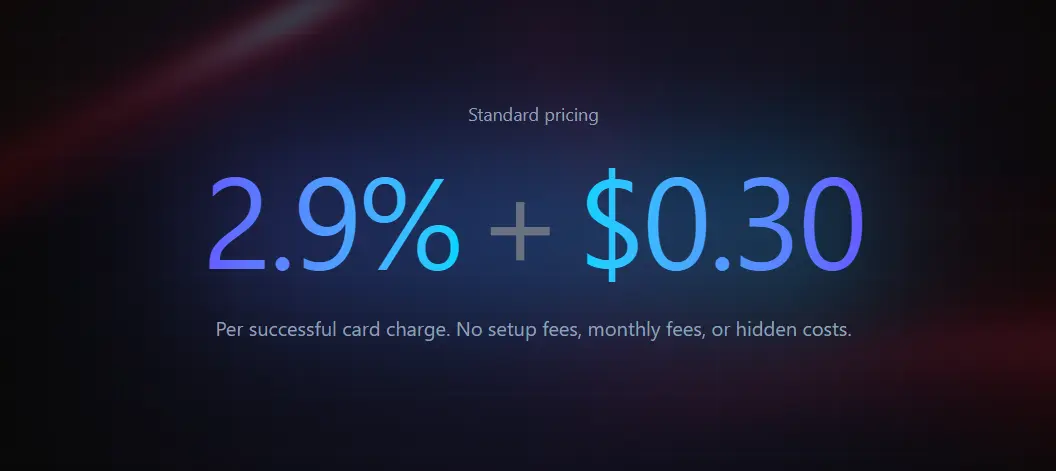
The baseline pricing for Stripe in the US is 2.9% plus $0.30 per successful card transaction. This covers most standard online payments — credit cards, debit cards, and digital wallets like Apple Pay and Google Pay.
For European cards, the pricing is different. Standard European card payments cost 1.5% plus 0.25 euros per transaction. UK cards cost 2.5% plus 0.25 euros, and international cards processed in Europe are charged at 3.25% plus 0.25 euros. These stripe fees are competitive for the European market and generally lower than what PayPal charges for the same transactions.
What is included in the base rate
The base stripe fees cover quite a lot. You get access to the full Stripe dashboard, fraud detection via Stripe Radar, support for over 135 currencies, automatic card updater, and basic dispute handling. There are no monthly fees, no setup fees, and no minimum transaction volumes. You only pay when you make a sale.
This pay-as-you-go model is one of the reasons Stripe is so popular with early-stage products. You are not paying anything until you are actually generating revenue, which removes a lot of financial risk from the early days of building.
Additional stripe fees to know about
Beyond the base rate, there are a few additional charges worth knowing about:
- Manually entered card transactions cost an extra 0.5% on top of the standard rate, because they carry higher fraud risk.
- International cards processed outside their home region add 1.5% to the transaction cost.
- Currency conversion adds 1% when Stripe converts the payment to your payout currency.
- Instant payouts, which let you access your funds within 30 minutes rather than the standard 2-day payout cycle, cost 1% with a minimum of $0.50.
- Disputed charges result in a $15 fee, which is refunded if you win the dispute.
None of these are hidden, but they can add up if your business has a lot of international customers or a high dispute rate.
How Stripe Fees Compare to the Alternatives
Understanding stripe fees in isolation is only half the picture. The more useful question is how they compare to the main alternatives.
Stripe vs PayPal
PayPal is the most direct competitor to Stripe for online payments. The standard PayPal rate for online transactions in the US is also 2.9% plus $0.30, which looks identical to Stripe at first glance. But the comparison gets more nuanced when you look at international transactions and the overall developer experience.
For European transactions, PayPal charges 2.9% plus 0.35 euros, compared to Stripe's 1.5% plus 0.25 euros for European cards. That is a meaningful difference if a significant portion of your customers are in Europe.
Beyond the numbers, Stripe wins on developer experience by a wide margin. The API is cleaner, the documentation is better, the webhook system is more reliable, and the dashboard gives you more useful data. For a developer building a product, these differences matter as much as the fee structure.
Stripe vs Square
Square is primarily designed for in-person payments and retail businesses. Its online payment fees are 2.9% plus $0.30, the same as Stripe on the surface. But Square's developer tools are significantly less mature than Stripe's, and it lacks many of the features that make Stripe the right choice for SaaS products, such as subscription billing, usage-based pricing, and advanced webhook handling.
If you are building a physical retail business, Square is worth considering. If you are building a web application or SaaS product, Stripe is the better fit.
Stripe vs Braintree
Braintree, which is owned by PayPal, targets larger businesses and offers a similar fee structure to Stripe. For high-volume merchants, Braintree can negotiate custom pricing that may be lower than standard stripe fees. However, Braintree's developer experience is generally considered inferior to Stripe's, and the integration is more complex.
For most developers and early-stage products, the potential savings from Braintree's custom pricing are not worth the added complexity. Stripe's volume discounts, which kick in at scale, make it competitive for larger businesses as well.
Why Stripe Is Worth the Cost
Stripe fees are not the lowest in the market. There are processors that charge less per transaction, particularly for high-volume businesses. So why do so many developers and founders choose Stripe anyway?
The developer experience is genuinely excellent
Stripe's API is one of the best-designed APIs in the industry. The documentation is comprehensive, the error messages are clear, and the testing tools make it easy to simulate different payment scenarios without touching real money. For a developer, this translates directly into faster integration and fewer bugs.
The Stripe dashboard is also genuinely useful. You can see your revenue, your customers, your subscriptions, and your disputes in one place. You can issue refunds, create payment links, and manage your product catalog without writing any code.
Webhook reliability matters more than you think
One of the most important parts of any payment integration is the webhook system, which is how Stripe notifies your application when something happens — a payment succeeds, a subscription renews, a card is declined. Stripe's webhook system is reliable, well-documented, and easy to test locally using the Stripe CLI.
Getting webhooks wrong is one of the most common sources of bugs in payment integrations. Stripe makes it hard to get wrong by providing clear documentation, signature verification to prevent spoofed events, and a dashboard that shows you every webhook event and whether it was delivered successfully.
Subscription and SaaS billing is built in
For SaaS products, Stripe's subscription billing features are a major advantage. You can create products, prices, and subscription plans directly in the dashboard or via the API. Stripe handles recurring billing, failed payment retries, proration when customers upgrade or downgrade, and tax calculation in supported regions.
Building all of this from scratch would take weeks. With Stripe, it is available from day one, and the stripe fees for subscription billing are the same as for one-time payments.
Fraud protection is included
Stripe Radar, the fraud detection system included in the base stripe fees, uses machine learning to identify and block fraudulent transactions. It is trained on data from millions of businesses across the Stripe network, which means it has a much larger dataset than any individual business could build on its own.
For most businesses, Stripe Radar significantly reduces fraud losses without requiring any additional configuration. You can also add custom rules to block specific types of transactions if you have particular concerns.
Compliance is handled for you
Payment compliance is complex. PCI DSS, the security standard for handling card data, requires significant effort to implement and maintain. Stripe handles PCI compliance on your behalf, which means you never store raw card data on your servers and your compliance burden is dramatically reduced.
This is one of the less visible but most valuable aspects of using Stripe. The cost of a PCI compliance audit or a data breach would far exceed any savings from using a cheaper payment processor.
When Stripe Fees Might Not Be the Right Fit
Stripe is the right choice for most web applications and SaaS products, but there are situations where the stripe fees structure is not ideal.
Very high transaction volumes
At very high transaction volumes, the percentage-based stripe fees can become significant. A business processing millions of dollars per month may be able to negotiate better rates with Stripe directly, or may find that a processor with interchange-plus pricing offers lower effective rates.
Stripe does offer custom pricing for high-volume businesses, so it is worth having that conversation before switching to a different processor.
Very low transaction values
For products with very low average transaction values, the fixed $0.30 per transaction component of stripe fees can represent a large percentage of the total. A $1.00 transaction costs $0.33 in fees, which is 33%. For micropayment use cases, a different pricing model may be more appropriate.
Conclusion
Stripe fees are transparent, competitive, and come with a level of developer tooling and reliability that justifies the cost for most products. The standard 2.9% plus $0.30 for US transactions is in line with the market, and the European pricing is genuinely competitive compared to alternatives like PayPal.
More importantly, the value you get beyond the transaction processing — the developer experience, the webhook reliability, the subscription billing, the fraud protection, and the compliance handling — makes Stripe the right default choice for anyone building a web application or SaaS product in 2026.
The stripe fees are not the cheapest option available. But for most developers and founders, they are absolutely worth it.
Content was rephrased for compliance with licensing restrictions. Sources: Stripe vs PayPal Fees 2026, Stripe European Pricing, Stripe Fees Full Breakdown